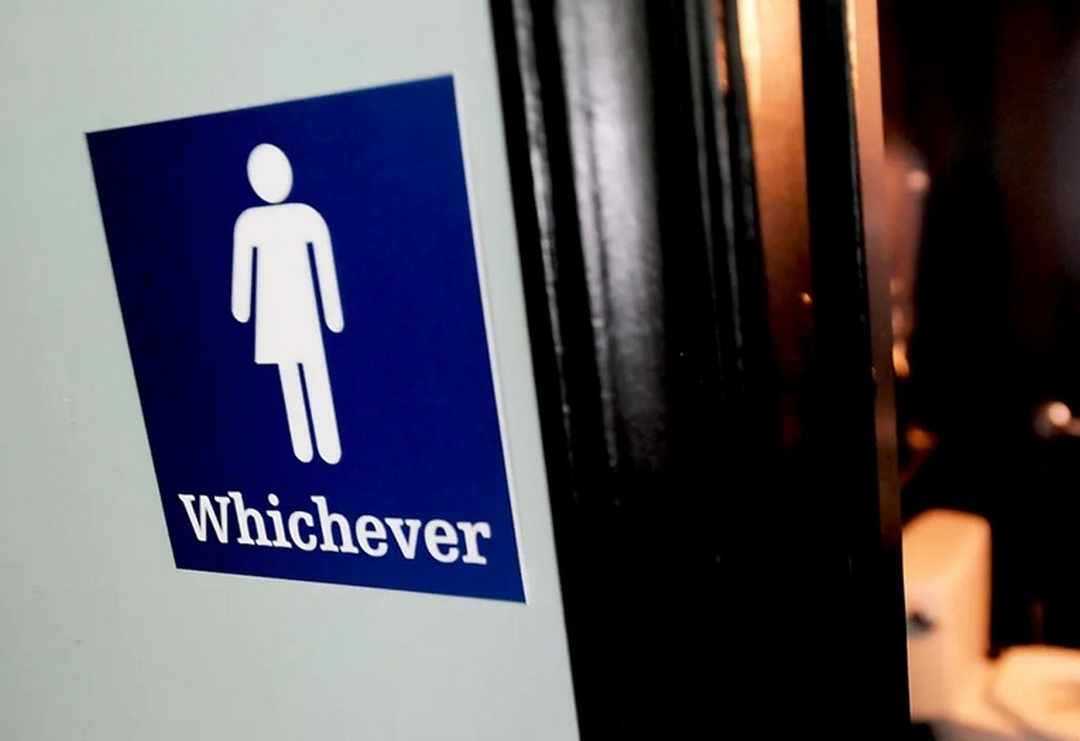
Transgender people could be banned from single-sex spaces based on how they are perceived by other people according to the Times. The newspaper reports seeing a copy of the Equality and Human Rights Commission’s transgender guidance that was handed to ministers in early September.
The EHRC was never going to please both sides of what has become an impassioned debate. Now it seems that they have come up with a code of practice that could well please neither. The gender identity lobby will hate it because it will require transgender people to put on some sort of performance to access spaces designated for the opposite sex. Meanwhile, those who have championed the Supreme Court ruling that sex means biological sex will likely be outraged if a good enough performance will be good enough to open the door to those spaces.
But it’s not the EHRC’s job to satisfy either side of the debate; their task was to draw up guidance that is workable in practice. ID checks on public toilets, for example, are never going to work. Widespread annoyance caused by the sheer inconvenience to everybody would see to that. Besides, sex markers can be readily changed in any case.
Kishwer Falkner – the chair of the EHRC – has shown huge bravery since she was appointed in December 2020. She started by withdrawing the Commission from the Stonewall Diversity Champions Scheme. She stood up for women at a time when too many people appeared to have been brainwashed by the Stonewall mantra, ‘Trans women are women, get over it!’ Falkner set out to defend the right of women to question transgender identity without being abused, stigmatised or risking losing their job. She was right, but she suffered dreadfully from those who considered transgender identities to be sacrosanct.
As her term of office comes to an end, will she now upset those who consider biological sex to be paramount? Apparently, the draft code states that it would be ‘unlikely be proportionate or practical to ask for further evidence of a person’s sex’, even if doubts were raised. That is probably not what those campaigners want to hear.
The problem for those arguing an absolutist position is that while sex matters, sometimes the perception of sex matters more. The Supreme Court judges recognised that back in April. In paragraph 221 of the landmark judgment FWS v Scottish Ministers, they said:
Women living in the male gender could also be excluded [from women’s single sex service] without this amounting to gender reassignment discrimination. This might be considered proportionate where reasonable objection is taken to their presence, for example, because the gender reassignment process has given them a masculine appearance.
Supreme Court Judgment FWS v Scottish Ministers (paragraph 221)
Especially where nudity or potential nudity is an issue, men might reasonably object to the presence of a transwoman – like me, for example – who has completed a process of medical and surgical transition. Those who suggest that men simply get over themselves and take us back in are missing the point. Our bodies no longer look like theirs.
So, where do we go from here? Ideally, additional private facilities should be available alongside the men’s and the women’s for anyone who does not want to share with their own sex. That works for me both in my work, and when I am out and about in town. But what happens when there is no alternative? That dilemma is at the heart of the problem the EHRC has had to grapple with.
Maybe the best advice is to do what we have always done, until the madness of the last few years. Previous generations of human beings never needed paperwork to distinguish men from women. Nor did they need any knowledge of gender identity or chromosomes. They used their common sense, i.e. that evolved instinct that we in turn have inherited. We probably share it with most other species. Indeed, a species that could not tell the difference between the male and female of its own kind would probably not contribute much more to evolutionary history.
Human beings, however, are now able to change their appearance, including their external sexual characteristics. We call it ‘transition’. That genie is unlikely to be ever put back in the bottle. Even if gender reassignment processes are banned in the UK, we can hardly stop individuals travelling to such places as Thailand where clinicians work for a fee. Gender reassignment does not change our sex (that really is impossible, at least for now), but it can and does change the way that other people perceive our sex. It is those perceptions that drive our emotions, and hence the way we relate to each other.
That idea won’t be popular with either side of the debate in which one side argues that transition is unnecessary (‘you shouldn’t need to transition to be transgender’), and the other argues that it is ineffective (‘you’re still a man, Debbie’). But those statements describe the worlds that the respective sides think ought to exist. In the real world, human beings use their instincts.
The code of practice has still not been published. Maybe Keir Starmer and Bridget Phillipson – the minister responsible – fear the wrath from both sides of the debate? But they need to get on with it. They have a responsibility to govern, and businesses, service providers and public bodies are desperate for guidance, and that includes principles to work from.
A wise inclusion would be the principle of least surprise. Transgender people who use the facilities that cause the least surprise to those around them are likely to generate the least fuss. Yes, it leaves us hostage to the thoughts and feelings of those around us, but hasn’t that always been the case?
Debbie Hayton is a teacher and journalist.
Her book, Transsexual Apostate – My Journey Back to Reality is published by Forum
* This article was first published by The Spectator on 20 November 2025: There’s no easy way to manage single-sex spaces.

 Debbie Hayton
5 replies on “There’s no easy way to manage single-sex spaces”
Hi, Debbie. I think in your final paragraph, you come up with the most workable solution.
Now, I’m going to get personal in this post. I have looked at a lot of pictures of you over the years, and you have a distinctive face. It doesn’t strike me as either a feminine or a masculine face. If I weren’t familiar with you, and you were dressed as a woman, I might think “interesting woman” were I to see you entering a ladies room, but I would not create a scene. (For that matter, nor would I create a scene if I saw 6-foot-2-inch Caitlyn Jenner entering a ladies room. Only the brashest among us would do such a thing.)
I do need to say, however, that some people do seem to have a naturally androgynous look, so “instinct” doesn’t always save the day.
If transgender activists would back off their most outrageous demands, the entire issue would be diffused, and this willingness to “ignore what one sees even if it doesn’t look 100% normal” would naturally prevail.
The problem is that the unreasonable demands continue, and as long as they do, the rest of us will be inflamed. And as long as we are inflamed, the arguing and confrontations will continue.
Regarding you personally, you seem to walk a tightrope between hoping that you pass well and worrying that maybe you don’t. Since you have had a lot of surgeries, perhaps if you went in for facial feminization surgery, that might put you “over the top” in terms of passing as a woman. (If you have already had facial feminization surgery, then I have just committed a serious faux pas.)
LikeLiked by 1 person
My hypothesis is that the concepts ‘man’ and ‘woman’ link to our perception of other human beings rather than to their reproductive biology or their so-called gender identity. Rather than prove it by argument I am testing it by hypothesis. If I am wrong, then I will know I am wrong when my theory is not confirmed by experiment.
If I am right, then neither side will prevail in the gender debate. Likely they will exhaust each other in a stalemate. Meanwhile children are still being experimented on. That is the current horror that I want to see stopped as soon as possible.
LikeLiked by 1 person
I get the feeling I may have offended you somehow, as you sound a little angry. If so, I apologize. Perhaps I don’t fully understand the situation, given that I am in America; or maybe trying to apply what you wrote to you personally was a step too far. I am going to re-read your article and my response.
LikeLike
Hello Caleb, I am so sorry if I sounded a bit angry. I wasn’t, and I certainly wasn’t offended. As always I appreciate your comments and I was trying to add to them. Maybe the stress of finishing off work before Christmas is getting to me? I hope you have a great Christmas yourself.
LikeLiked by 1 person
I don’t know why you sounded angry. When I re-read what you said, I don’t see the anger. It must have been the mood I was in.
I’m suddenly having problems with passwords on WordPress.
LikeLiked by 1 person