Removing the sex marker would not be a progressive step
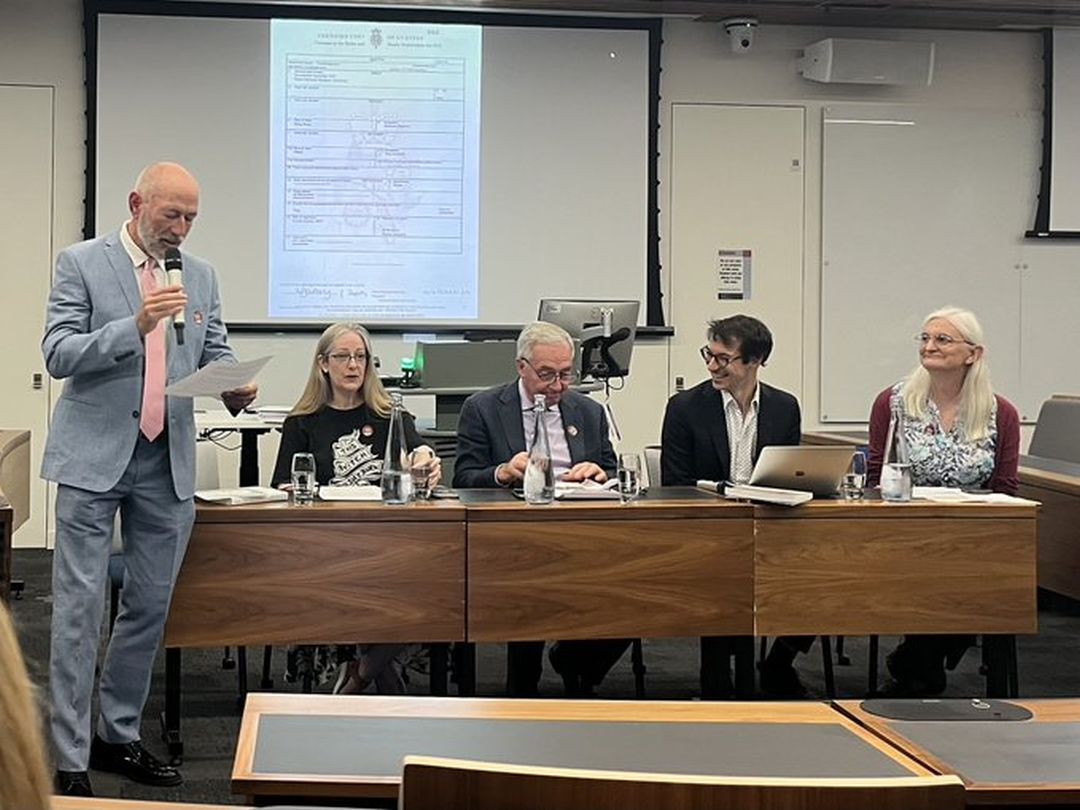
This piece was adapted from my contribution to a debate held to mark the launch of Robert Wintemute’s book, Transgender Rights vs. Women’s Rights: From Conflicts to Co-Existence at Bush House on 16 June 2025. The question was, “should sex be removed from birth certificates?” The panel consisted of Robert Wintemute, Helen Joyce, David Anderson (chair), Benjamin Moron-Puech and Debbie Hayton.
A binary question deserves a binary answer, Yes or no? After nine years in this debate – I first opened my mouth in the autumn of 2016 – I know what I think, and I agree with Helen Joyce. Sex should not be removed from Birth Certificates.
But the question also raises lots of issues. What reasoning do I have to support my assertion? and what hypotheses can I use to test it? Indeed, if there is no way of proving that I am wrong, how can I be sure that I am right?
However, I want to digress for a moment. I am transsexual and people sometimes assume that I have a different perspective on this question. Actually, I don’t. Like everyone else who was born in the UK I have a birth certificate, and it states quite clearly that a boy was born on 23 April 1968. It also records the names of my parents and my father’s occupation.
That is a reliable record of something that happened. Does it bother me as a transsexual that my birth certificate says ‘boy’. Absolutely not! It records the truth. I was a boy. And I don’t need to obscure the past – or indeed change the past – to live in the present. I rather like the way that in 1968, birth certificates still indicated ‘boy’ or ‘girl’. They recorded faithfully the primary evidence that was observed and agreed upon by those present at the birth.
So, back to the question. Why do I respectfully disagree with Benjamin? Firstly, the scientist in me loves meaningful data. Sex observed at birth is meaningful because different observers will come to the same conclusion. If that data is not recorded consistently – and in the same place for each new person – then it’s harder to compare the subsequent experiences of the two sexes. Society would be poorer for that.
Secondly, I am a parent myself. After each of my three children were born, I reported the happy news to family and friends. I quickly found out that if I didn’t say ‘boy’ or ‘girl’, they would want to know, women especially. This was clearly very important information. I don’t think that my experience was unusual, I’d hypothesise that the ‘need to know’ is more general, and it’s a hypothesis I could test through controlled research.
But why do they need to know? I don’t think they are being prurient; I think they are being human. Babies are born to their parents but, throughout history, they were a blessing to the wider community – which therefore had an interest in them. Society might have evolved, but human instinct remains.
These days, common knowledge has been supplanted by government paperwork. Removing sex from birth certificates would leave parents in a more powerful position to lie about the sex of their children. Child transition is a new thing, but parents who project their own wishes onto the lives of their children are not. Four years down the line, I worry that primary schools would see a significant increase in the number of boys being registered as girls, and girls being registered as boys. That hypothesis, however, I would not want to see tested.
Finally, on a more fundamental level, I’d argue that it is futile to try to pretend that sex does not matter. Our need to distinguish boys and girls, men and women, is about conveying a biological fact, but it is also more than that. It is an evolved instinct, mediated by emotions, that’s much older than our own species. One thing the last ten years have taught me is that attempts to use law and policy to override human nature do not work.
You might be able to remove sex from a birth certificate, but you will not remove sex from human beings. All you will do is make it more difficult to describe and explain how sex affects human beings. That is not progress.
Debbie Hayton
Orginally spoken on 16 June 2025 at Bush House, London.
Transgender Rights vs. Women’s Rights: From Conflicts to Co-Existence by Robert Wintemute is published by Polity. 228pp

 Debbie Hayton
9 replies on “Sex must stay on birth certificates”
“You might be able to remove sex from a birth certificate, but you will not remove sex from human beings. All you will do is make it more difficult to describe and explain how sex affects human beings.” In a nutshell. Thanks, Debbie for a succinct and common sense observation.
LikeLiked by 1 person
I can’t tell from your article what the situation is in England. I gather that sex is presently a category on the birth certificate which is expected to be filled in. Or are you talking about parents changing the information — male or female — at a later date? Sorry for being dense. If the debate is whether the category should be removed, that will certainly make it harder to gather statistics. I can imagine, though, that a lot of trans people would like that.
I think that truth is its own value, if you now what I mean. Society must be based on facts, not on fictions. If the category were removed, I believe doctors would probably start writing the information in the margins.
LikeLiked by 1 person
Sex is recorded on birth certificates as observed at birth. This hinders parents from creating the fiction that their child is the opposite sex. If sex is removed from birth certificates then it will become easier for parents to create this fiction without being detected.
LikeLike
It will make tracing family history impossible, as ppl had children over 20 yrs siblings ages can be 20 years apart, as can husband and wives. Names are often the same. Surname spellings changed because ppl couldnt write, the registrars may spell them different to each other, so over time surname spellings change, eg in our family we found them spelt- Mackie, MacKay, MacKie McKie….The only fact that is easy and important to find that never changed was females gave birth, males were the fathers.
Tracing family history many times we came upon an important link in the chain – a woman who couldnt write, she put an X on marriage cert … she was unimportant to the world, but she gave birth to the next generation so without her, the link was broken so she was very important to us.
Removing sex on birth certificate or changing it, effectively erases our ancesters from being found. How is this following one of the basic commandments our laws are based upon? “Honour thy father and thy mother”
LikeLiked by 1 person
I agree with your concerns about tracing family histories. It was one reason why I did not want to get a GRC. In my view there is no need to change the past in order to live in the present.
LikeLike
I think what worries me is that if adults can choose to have their birth certificate changed this means that in effect they can ‘ start again’ in which case potentially worrying information about some who are using the system may be hidden? I don’t know what the legal position is but it appears this could be a loophole for those who would take advantage and sadly there are always some.
LikeLiked by 1 person
I share your concerns. They should not be able to do this. I don’t think that it is a legal loophole, but I worry that it is too difficult to catch people how might use the GRC process for fraudulent purposes.
LikeLike
Yes, an important point. It reminds me of the rebuttal we always get about women’s spaces, that we’re assuming ‘transwomen’ are predatory; they won’t all be (I’m assuming you’re not, for example), but open a loophole in the law and sure enough some people will shove a monkey-wrench in there.
LikeLiked by 1 person
If women say ‘yes’ to me then they might find it much harder to say ‘no’ to someone else if their response is, ‘you let Debbie in, why not me?’
LikeLike