
Thank the Lord for some common sense. In this case, thank Lord Hodge, who yesterday* delivered the UK Supreme Court’s unanimous ruling that trans women are not biologically female.
Extraordinary as it is that such an obvious statement requires an 88-page judgment, compiled over many months by the highest court of appeal in the country, this decision is crucial.
It was a momentous day for women and for the law. An era of collective madness is over – though we must not be complacent, because the angry brigade are likely to continue their attempts to impose their demands through bullying. They will keep bellowing ‘trans women are women’ through their megaphones and hurling vile threats at anyone who dares oppose them.
The war isn’t over, but the turning point has been reached. In most circumstances, at least, no longer will any man, whether he’s sporting a wig and make-up or a full beard, be able to wave a piece of paper headed ‘gender recognition certificate’ and insist the rest of us acknowledge his legal right to be recognised as female.
This represents a victory for women and girls everywhere, and a major step towards enhancing their safety.
I’m especially grateful to the court for emphasising that the ruling does not represent a ‘defeat’ for trans women. On the contrary, it’s an accurate and reassuring reflection of who people like me really, biologically are.
We all instinctively know the difference between men and women, despite the powerful lobby that has tried its damndest to deny it. I’m fortunate in being a science teacher with a thorough grasp of biology, so I’m well able to articulate the truth behind the common sense.
Adults who, like me, need to change their appearance and even their physical shape, in order to feel comfortable in their own skin, should be able to do so safely. Everyone ought to respect that need. But it doesn’t alter the basic reality that, as the Supreme Court has ruled, ‘the concept of sex is binary’.
The biology of sex is much more than just reproduction. It affects the development of our bodies, most obviously during puberty but quite profoundly from the moment of conception. Throughout the nine months before birth, human bodies develop according to their sex, and that continues to be true during each minute of childhood.
Boys and girls develop along different paths. Social conditioning plays a part, naturally, but that only modifies the effects of biological sex.
I have immense admiration for the campaign group For Women Scotland, who have fought fearlessly every step of the way. They’ve battled through the courts in Scotland and then England, through the High Court and the Court of Session, all the way to the Supreme Court.
It’s due to their courage and tenacity that sanity has been restored to the law of the UK. Campaigners in other countries that are still living in a legal fantasy world of trans delusion will take great hope from this.
Politicians of all parties have failed women during this long battle. Most egregiously, Sir Keir Starmer was spouting nonsense when he claimed some women had penises. He’s a lawyer, and I trust this ruling has helped him to remember the difference between men and women.
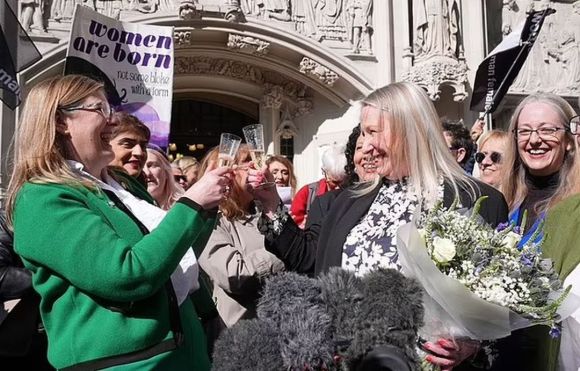
We shall have to see how the government reacts to the ruling. Predictably, some Labour ministers are taking the line that this verdict just confirms what they’ve been saying all along – which is, of course, not true. I whole-heartedly challenge the line taken by MP Nadia Whittome who said yesterday: ‘I share the deep disappointment in today’s Supreme Court ruling, and the concerns about what this will mean for trans women going forward.
‘Today and every day, I stand in unwavering solidarity with the trans community. We must never stop fighting for trans rights.’
Labour should have offered support to biological women from the moment they came to power, since the law as it stood was incoherent.
The blame for that falls on previous administrations, who allowed confusion and inconsistency to multiply because they were too intimidated by the trans lobbyists.
Theresa May, when she was prime minister, pledged to usher in the crazy world of gender recognition certificates by self identification alone. We’ve seen male domestic abusers strong-arm their way into women’s spaces, male athletes using their masculine physiques to gain a biological advantage in women’s sports, and male voyeurs sidling into women’s changing rooms.
All these outrageous and dangerous distortions of common sense were made possible by a Conservative administration that was too weak to act. But the scandal goes back further still, to the Blair era, when the Gender Recognition Act was introduced without sufficient regard for common sense. Politicians have had numerous opportunities to turn the tide, but lacked the willpower and the gumption shown by For Women Scotland.
So I’m grateful to the Supreme Court for their decision. The judges could have copied the politicians and hidden behind a wall of excuses. They might, for instance, have claimed that, as the Equality Act doesn’t define what a woman is, the responsibility to clear up this mess lay with parliament.
In that case, the controversy would have probably dragged on for years. Instead, the court took firm action. That’s a sharp admonition to the government, though I don’t expect Downing Street will admit it.
Most of all, I welcome the ruling as a teacher, whose mission for nearly 30 years has been to guide and educate children. When I decided to transition, I was a full adult. I knew my own mind, whatever happened.
That cannot be said of any teenager or pre-pubertal child. They are not old enough to make responsible decisions that will have drastic and lifelong consequences, such as altering their bodies with hormones and surgery.
I only began ‘socially transitioning’ in 2012 – at the age of 44. I started to change my appearance and my wardrobe. I experimented with make-up and attempted to be seen as a woman.
Other people responded by referring to me using female pronouns. A year later, I began hormone treatment provided by the NHS.
Difficult though this was for my wife Stephanie and our three children, we all stayed together. And despite all the inevitable problems I faced at the school where I worked as a science teacher, the transition brought me huge relief.
I’d been secretly trying on women’s clothes since I was a small child, and began buying my own at 14. Decades of concealing my inner turmoil was coming to an end.
In 2016, I took the ultimate step of undergoing gender realignment surgery on my genitals. My body is now female to all appearances, but I’m a trans woman, a man who has gone to great lengths to look female, and who ‘lives as a woman’. There’s a very significant difference – and one that the law now acknowledges.
There are two sexes, male and female, and sex cannot be changed. Trans women certainly exist – I’m one of them. But trans women, however loudly the slogans blare, are not women.
Debbie Hayton is a transgender teacher and journalist
* This article was first published by The Daily Mail on 17 April 2025: An era of collective madness is over. This is not a ‘defeat’ for trans women, it’s an accurate reflection of who we really are.

 Debbie Hayton
8 replies on “An era of collective madness is over. This is not a ‘defeat’ for trans women, it’s an accurate reflection of who we really are”
Thank you for another great article, and thank you for being courageous enough to acknowledge the truth while so many of your “sisters” promote the delusion.
The Supreme Court ruling had an interesting effect over at the Washington Post, a paper which has been 1000% in favor of everything trans, so much so that I sometimes wonder if only trans women work for it. A few days ago, or perhaps a week, when the ruling first became public, the Post, which seems to have become a tad more conservative since Trump took over, published two articles. One was an editorial acknowledging the fact that people who believe in the supremacy of biological sex may have a point. But the other article was written by a “trans-women-are-women” type journalist who bemoaned the fact that so many “women” had lost their rights (in England, if not in the U.S.). He talked about how lost some of them felt, and how painful it would be that they could no longer enjoy the women’s spaces they felt entitled to or play on the sports’ teams of their choice. The tone was clear: “We thought we had won this battle.”
But that was never true in either country. The vast majority of people in both countries never signed onto the idea that “a trans woman is a woman” — NEVER. Instead, the progressives and liberals just blew right past them and started pretending that there was a new normal.
Judges in the U.S. are still ruling that “a trans woman is a woman”, and this S.C. ruling will (hopefully) bring a course correction to the U.S. courts.
So what are trans women to do? Well, they’ll have to leave women’s single-sex spaces if their presence makes the real women feel uncomfortable. But in most cases, nothing will change. People will continue to look at them a little oddly (as they try to figure out what they are, male or female), and then will treat them as the women they want to be. “Live and let live” will prevail.
As for me, I look forward to the time when my gay brethren stop calling me a bigot and a hateful transphobe, when what I have is simply a clearer picture of reality.
LikeLiked by 2 people
I suspect that if a transwoman takes the effort to fit in and not cause a fuss then you might be right. But if the transwoman expects the rest of the world to change their way of thinking then that transwoman is in for a rude awakening.
LikeLiked by 2 people
I’ve written about that young man from the 1980’s who is, today, probably a trans woman. The intensity of his feelings was very evident. So too with Wendy Carlos (formerly Walter Carlos of Moog Synthesizer fame), whom I also met, and who transitioned while he was still famous. It is clear that trans feelings are intense, as you described in your book (trying to keep the beach ball under water). For people who have genuine gender dysphoria, and who aren’t just part of the fad, this is a real, existential issue. Thus, society must accommodate it. But when a minority is so small, it can only make so many demands on society.
LikeLiked by 2 people
It’ll be a long road back to sanity. The gender ideologues are so entrenched in all our main institutions, from the NHS and BBC to local councils and the British Government.
Earlier this month, there was a vote in Parliament on a Conservative amendment to the Data Bill, on whether sex should be recorded on ID documents, as per the clarification from the Supreme Court. Only 97 MPs voted for it, while 363 voted no. The Ayes were all Conservative, of course, except three Reformers, the independent Rosie Duffield, and one from Traditional Unionist Voice, the Noes mostly Labour and Lib Dems. While it could be argued that the Equality Act and other relevant laws can operate fine despite people’s passports and driving licences and other documents bearing fictions, it seems a stupid and pointless complication, and will help to maintain cultural investment in the unscientific notion of a kind of pseudo-official transgender identity alongside sex. It also seems dangerous, in the case of emergency and the need for medical treatment if any documented sex isn’t reliable.
Not to mention the pissing protests and men still insisting on invading women’s spaces, like the swiming lakes at Hampstead Heath (despite there being a male pool, female pool AND a mixed-sex pool), etc., etc.
LikeLiked by 1 person
I wonder if recording sex on ID cards and passports PLUS a field which can be checked called “transgender” might not be a solution. Of course, trans identities can change over time.
LikeLike
I wouldn’t want a transgender marker on my passport. There are some places in the world where that might be an issue.
LikeLike
We all know the difference between men and women. Any law or policy that tries to override our evolved instincts will lead to absurdeties sooner or later.
LikeLike
If we always put sex on ID documents, what absurdities will result?
LikeLike