
The comedian found himself out of work and out of his marriage when he challenged the transgender ideology that to be a man or women is about choosing an identity
Graham Linehan is an unlikely political campaigner, but in 2018 the sit-com writer embarked on a second career in what is possibly the most contentious and vitriolic arena of our time. According to Linehan, he was fighting for women and children, but his advocacy has cost him dear. Accused by his opponents of transphobia, he has found himself out of work and out of his marriage.
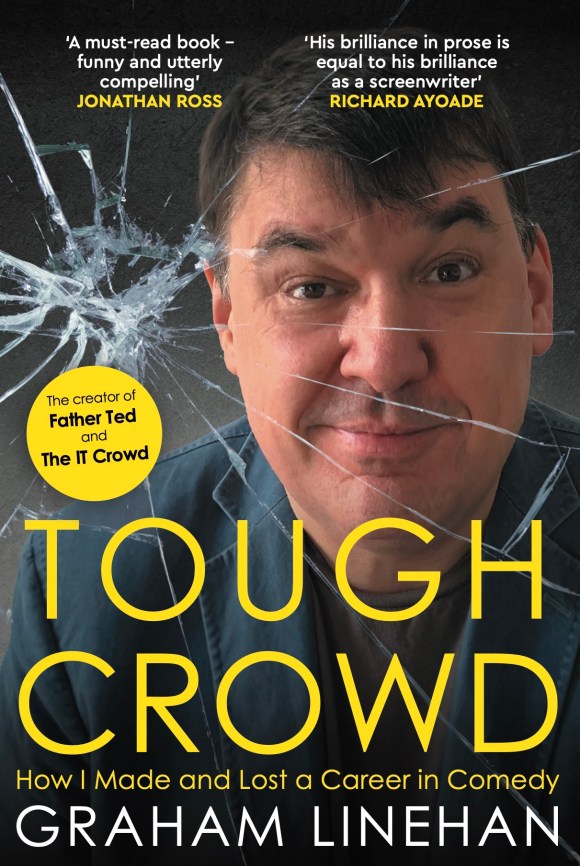
In Tough Crowd, he tells the story of how he ‘made and lost a career in comedy’. It’s a tough read – a man who once made so many people laugh saw his career come to a ‘screeching halt’. Love him or loathe him, he is undeniably forthright and unapologetic. On the core tenet of transgender ideology – that to be a man or a woman is a matter of choosing an identity – he is scathing:
If we manage to successfully rewire our brains to such an extent that we see Eddie Izzard as a woman and [Elliot] Page as a man, it will be easier for opportunistic predators like Adam Graham – the double rapist almost admitted to a Scottish women’s prison by Nicola Sturgeon’s government – to access single-sex spaces across society, not just in prison.
Graham Linehan, Tough Crowd
Jobs began falling away, while a tour to Australia to teach comedy was cancelled by the company Frontier because they ‘wouldn’t be able to afford the security’.
The impact on Linehan’s personal life was profound. He describes how his 16-year marriage to the writer Helen Serafinowicz broke down under the strain. He reflects that his wife ‘was perfectly within her rights to ask me to cease operations’. She was looking for normality, and a life where family occasions were not overshadowed by his activism.
Social media, however, is unforgiving. As Linehan explains:
Turning on a comments section under our lives was a surveillance system we installed ourselves, ensuring we could never get too far out of line, never push too hard against what was suddenly the ‘majority’ opinion. I pushed back and I lost everything. But I knew from day one that it was too important a fight to turn down.
Graham Linehan, Tough Crowd
Elsewhere Linehan sums up his reasons: ‘The same question kept coming, over and over. “Why do you care so much?” “Why do you not?” was all I could say.’ He is critical of the individuals who have made his life so difficult; he also puts out a warning to those in authority who should have known better:
When the history of these years is written, it’s not only the extremist activists who will be recalled with revulsion, but also the spineless corporate figures who never even made an attempt to resist them.
Graham Linehan, Tough Crowd
But this book is far more than a catalogue of the afflictions faced by Linehan during the past five years. He shares the stories of others who have challenged the transgender narrative and suffered dreadfully as a result. The choreographer Rosie Kay, who lost the company that bore her name, and the children’s author Rachel Rooney, who wrote a book to help children feel happy with their bodies are just two examples.
Besides, the transgender wars are confined to the later chapters. This is a book of two halves, and the first half – the making of Linehan’s career in comedy – has a rather different flavour. These are not the pages that have been serialised ahead of publication. It is a memoir; the story of a boy from Dublin who became a writer for the Irish music press; how he met Arthur Matthews, with whom he would write Father Ted; why he crossed the Irish Sea to London; and how Father Ted and then The IT Crowd took off.
Tough Crowd, therefore, may well appeal to two completely different audiences – those who know Linehan for his television and those who know him for his politics. And while both might start first on the sections with which they are more familiar, if they want to understand the man then they need to read it all.
That is no hardship. Linehan is an accomplished scriptwriter and he tells a cracking story. The style is pacy and the 22 chapters each have their own focus and can be read individually or in sequence. You may or may not revere his sitcoms, and you may laud or despise his politics; but if you want to know how a music writer from Dublin ended up as one of the most notable commentators in the gender wars, then you need to hear it from the man himself.
Tough Crowd: How I Made and Lost a Career in Comedy, by Graham Linehan. Eye Books, pp. 286 £19 hardcover.
Debbie Hayton is a teacher and journalist.
* This article was first published by The Spectator on 11 November 2023: No laughing matter: accusations of transphobia wrecked Graham Linehan’s life.

 Debbie Hayton
4 replies on “No laughing matter: accusations of transphobia wrecked Graham Linehan’s life”
I have a prediction. Think back to the 1950’s and 1960’s when a variety of artists were blacklisted for supposedly being communist (some were and some weren’t, but even the ones who were had a right to their views). Many of those ostracized artists made their way back into their professions. I think the same thing will happen to Linehan. People are eventually going to get sick of the haters of cancel culture, and the haters will end up looking like the bad guys (which they are). People will begin to understand that trans people and their ideology are two separate things, and the ideology will eventually be rejected. Who knows, maybe Linehan will end up writing and producing sit-coms in Hollywood.
LikeLiked by 3 people
I wish there were more brave men like Linehan to stick up for women. This shouldn’t be just an issue that gets dumped on us. Why can’t men make space for trans women to be in their sports/changing rooms/showers/prisons? We are told that they would at physical risk in these environments. Well I think that should be looked into because it implies that its ok for men to discriminate but not for women.
I agree Caleb, I hope he finds his way back into a productive life and is not barred by frightened men who fear losing their jobs.
LikeLiked by 3 people
I’m going to face a similar issue when I publish my first book of poetry. I have written two anti-trans poems, and that will make a lot of publishers hesitate, and it will also give me an instant reputation as a “transphobe”, but those poems are definitely going into the book.
LikeLiked by 1 person
I’m with you 100%, Pauline! Unfortunately, I’m a big nobody, so nobody has taken much notice so far, just other nobodies on forums and youtube. But I speak out in those places, and the other day expected I might get my youtube account cancelled after I argued with a trans-identified male who was spouting all the usual rubbish. I ended my last comment bluntly reminding him he’s male. I thought he might get on to the thought police after that heinous misgendering, but he just shut up.
But that’s the thing, most of us have got something to lose, whether it’s just our social media account or a six figure income. I watched Graham’s interview with Andrew Doyle on UnHeard’s YT channel, where he rightly slams the comedy chums who went silent and refused to back him up, like Graham Norton, who called cancel culture “accountability culture” (interesting, as he’s been accused of sex offences). Linehan joins those dots, too, saying that “every Jimmy Savile who can’t DJ or get famous can now coordinate. You don’t need the keys to the hospital anymore.”
LikeLiked by 1 person