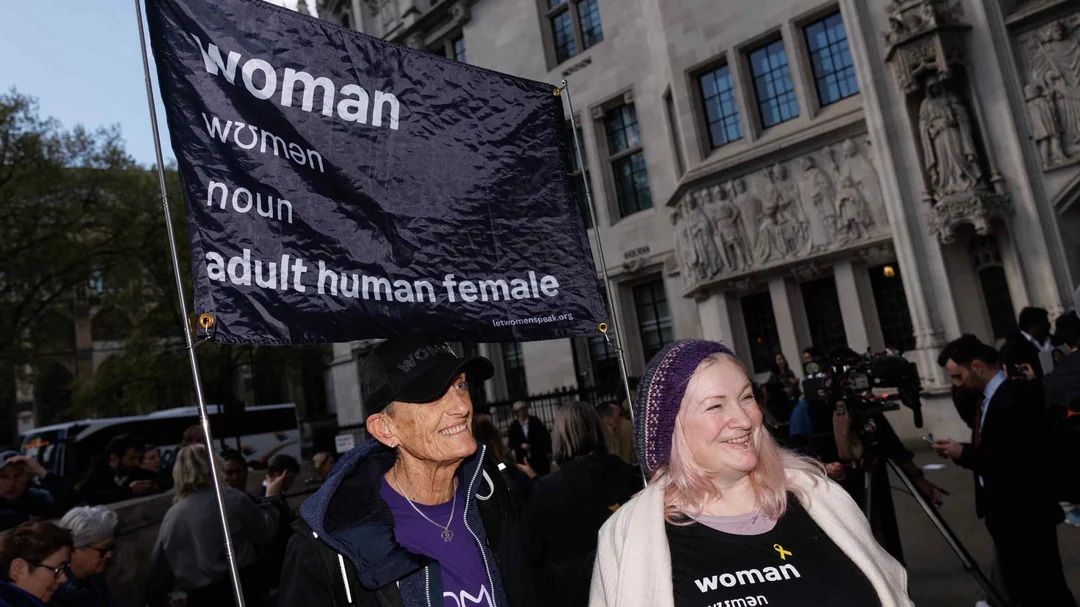
The UK Supreme Court has ruled that a woman is someone whose sex is female. The judgment, handed down this morning by Lord Hodge, sought to establish coherence in an area of law that has become the focus of an emotional, and sometimes heated debate. For that we should all be grateful.
The law as it stands is a mess. On one hand, the long-established principle that being a woman is a matter of biology underpinned the Sex Discrimination Act of 1975 – which stated most clearly that, ‘“woman” includes a female of any age, and “man” includes a male of any age’. When the law was updated in 1999 to include protections against discrimination on the grounds of gender reassignment, it did so without changing the meaning of sex.
On the other hand, though the Gender Recognition Act of 2004 declares that:
Where a full gender recognition certificate (GRC) is issued to a person, the person’s gender becomes for all purposes the acquired gender (so that, if the acquired gender is the male gender, the person’s sex becomes that of a man and, if it is the female gender, the person’s sex becomes that of a woman).
Gender Recognition Act 2004, Section 9
Seriously, what was Tony Blair’s Labour government thinking when this confused piece of wishful thinking was passed by parliament? It might have been forgiveable if the legislation had stopped at the word gender, but sex itself was dragged into the debate. This paragraph has been used to obfuscate reality; Lord Hodge cited it specifically as he explained the court’s decision that the protections set out in the Equality Act of 2010 should refer to biological sex rather than – as he termed it – ‘certificated sex’.
In brief (the full judgment runs to 88 pages), the court decided that ‘interpreting “sex” as certificated sex would cut across the definitions of “man” and “woman” and thus the protected characteristic of sex in an incoherent way’.
Of course it does! The resulting muddle and confusion has fuelled a febrile dispute that has been raging since around 2016 when transgender activists called for anyone to be allowed to self-identify their gender (i.e. legal sex) by statutory declaration alone. Shockingly, it was a Conservative government under Theresa May that caved in to those demands in order and pledged to do just that.
Thankfully, now, some semblance of sanity has been restored to UK law. No longer can the Scottish government try and expand the definition of the word woman to include someone who ‘is undergoing or has undergone a process (or part of a process) for the purpose of becoming female’. That sentence was taken from the Gender Representation on Public Boards (Scotland) Act 2018, which set out the objective for equal representation of women, but got bogged down in a debate over who was a woman, and how the Scottish government didn’t know its cervix from its prostate.
That piece of legislation also seeded the legal challenge that ultimately led to the Supreme Court judgement this morning. For Women Scotland, a grassroots campaign established by Magdalen Berns, Trinia Budge, Marion Calder and Susan Smith, are to be congratulated and thanked for their efforts and their advocacy.
There are loose ends that will need to be tidied up. The Gender Recognition Act creates a legal fiction and then obscures it. According to section 22 of the Act, ‘it is an offence for a person who has acquired protected information in an official capacity to disclose the information to any other person.’ That includes the fact that a GRC has been issued, and that the sex marker on a birth certificate has been changed.
How will providers of single-sex services cope with a transwoman on their doorstep who swears blind that they are a woman of the female kind? The provider can ask to see a gender recognition certificate, but there is nothing to stop the trans woman shrugging and saying, ‘what’s a GRC?’ After a birth certificate has been amended, the service provider is going to have a hard time proving their suspicions.
These issues are manageable, perhaps with small tweaks to the GRA. This might be coming Keir Starmer’s way. It is the job of government to make policy that is robust, coherent and does not contradict common sense. Let’s see if Starmer can manage it.
While I have skin in this game – I transitioned in 2012 – I don’t have a vested interest. I never bothered to apply for a GRC and I don’t use services provided for the other sex. The first decision was easy. I didn’t see any need to change the past in order to live in the present. The second took me a little longer, even in situations where I am known and respected. If I use women’s spaces, my female friends are going to have a harder time keeping out trans women whom they are not so happy with.
It does raise the question of whether the Gender Recognition Act is needed at all. There have been calls for it to be repealed, but following today’s judgment, it can now perhaps be left to wither on the vine. If a GRC no longer requires the law to treat someone as the opposite sex, then its key purpose is swept away without Starmer having to roll up his sleeves.
Debbie Hayton is a teacher and journalist.
Her book, Transsexual Apostate – My Journey Back to Reality is published by Forum
* This article was first published by The Spectator on 16 April 2025: This legal definition of ‘woman’ has restored sanity to the law.

 Debbie Hayton
4 replies on “This legal definition of ‘woman’ has restored sanity to the law”
This is great, Debbie. You selected an interesting set of facts that shed more light on the issue, so often distorted in the media. I hadn’t thought about the secrecy clause of the GRA, and I’m now wondering how on earth that’s going to be dealt with. However, I suppose it might only be clarified by another court case specifically concerning that (the law is definitely above my pay grade).
The – what shall I call it? – more radical trans community are going nuts after this, bringing up all sorts of ridiculous scenarios, usually involving toilets and often involving the necessity for genital checks. They almost entirely ignore the principle, which is that the sexes have a-priori rights to segregated spaces and activities.
I saw one person complaining that the same-sex strip-search rule meant that a trans person could be searched by someone of the opposite sex if they didn’t reveal their true sex (which, if it implies any insult or injury, is self-inflicted). Another suggested that male police officers might strip-search women by claiming they are trans (which seems to indicate a mistrust of police screening entirely beyond what is reasonable, despite recent infractions thereof). They seem to be throwing everything they can not-quite think of against the wall to see if anything sticks.
One scenario I’ve seen doing the rounds is that now “cis” men can just go in the women’s toilets and claim they’re “transmen” (i.e. female). Although this misses the point of the ruling, which is simply confirming that males do not have the right to enter female-only spaces (and vice versa), it might be a legitimate point, and some might try. I wonder what you think of the argument. One observation I’d make is that this sort of problem is a result – however indirect – of transgender ideology in the first place, and getting back to normality might be a bit of a bumpy ride.
I also wonder if you know the validity of the claim that the ruling says that sometimes trans people will not be allowed in spaces either for their sex or for the “gender” they identify with. On the face of it, this sounds insane, and I don’t know whether it’s true, a lie, or a misunderstanding.
Anyway, it’s comforting to remember we have the stalwart, steadfast Starmer at the helm. What can possibly go wrong?
LikeLiked by 1 person
Thank you. Agreed! Policy needs to account for common sense. Pie-in-the-sky wishful thinking has done so much harm these last few years.
LikeLiked by 1 person
In my experience toilets and changing rooms don’t tend to be policed so the only real difference this ruling will make us that if women complain of inappropriate behaviour they can’t any longer be accused of being a bigot.
I completely agree Debbie that the gender recognition act was a huge mistake and goes against all biological reality and will always enable bad actors to hide previous behaviour.
LikeLiked by 2 people
I think that the net result will be a shift in the presumption of what is right. Previously if a woman had complained about someone she thought was a man was in the women’s then – had she been vociferous about it – she might have been at risk of being hauled up before a court.
Now, if a man refused to leave, it would be more likely that a court would find that it was him who was at fault.
This is how it should have been all along.
LikeLiked by 1 person