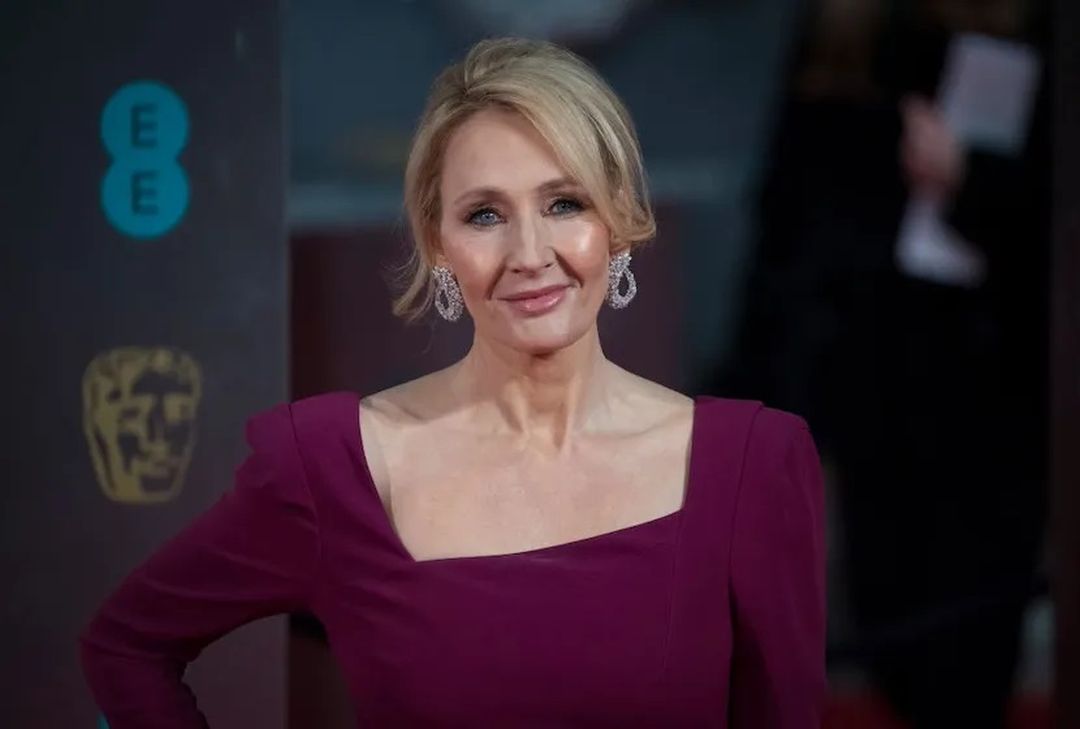
The transgender debate has a habit of bringing out the worst in people. It’s no wonder, really. It’s an issue rooted in identity – and therefore close to people’s hearts – and spiced up with the fear that fundamental concepts like the meaning of the words ‘man’ and ‘woman’ might be redefined by others, and to their advantage. It’s then hosted on social media – an environment where grown adults seem to forget that there are real life human beings involved.
Even the rich and famous can succumb. Over the weekend*, JK Rowling became embroiled in an unedifying spat over a transgender football manager. This is not premier league stuff. Lucy Clark hit the headlines in 2018 as the ‘world’s first ever transgender football referee’. Clark has now become the ‘first trans manager in the top five divisions of English women’s football.’
While the news was clearly important to a social media account calling itself @prideukorg, it’s not clear to me why anyone should really care. Football management is open to both sexes, and whoever a club chooses to manage its team is a matter for it and its supporters. However, it bothered Rowling enough to tell her 14.1 million followers on Twitter that, ‘When I was young all the football managers were straight, white, middle-aged blokes, so it’s fantastic to see how much things have changed.’
Any uncertainty over her mood was dispelled when she reacted to the inevitable outrage that followed. Mail Online suggested that she had compared Clark to a ‘straight, white, middle-aged bloke’. Rowling’s response was cutting, ‘I didn’t compare him to one. He IS one’.
Whether you agree with Rowling or not, her tone is remarkably different to the essay she wrote in 2020 when she set out her reasons for speaking out on sex and gender. Then, she wrote: ‘Trans people need and deserve protection’, and ‘I want trans women to be safe.’ Perhaps she has changed her mind in the four years that have passed? But in a lengthy and considered statement posted just last month she added:
‘Some people feel strongly that they should have been, or wish to be seen as, the sex class into which they weren’t born. Gender dysphoria is a real and very painful condition and I feel nothing but sympathy for anyone who suffers from it. I want them to be free to dress and present themselves however they like and I want them to have exactly the same rights as every other citizen regarding housing, employment and personal safety.’
JK Rowling
Has she changed her mind in a month? Or is she being manipulated by her environment? Twitter might have rebranded itself as X, but the rules of the game are the same. The quote-Tweet is possibly the most brutal weapon that exists on social media – especially in the hands of influencers with thousands of followers. Anything an opponent says can be captured and broadcast to your audience. Sarcasm, ridicule, or downright abuse then set the tone for the mob who can ‘pile on’ and deluge the original with more of the same, and worse.
If Twitter is anything it is a great leveller. Notable people with huge followings inhabit the same space as private individuals. But as well as sharing the same medium, human beings also share the same emotions. We like to be noticed and when the likes and (friendly) replies flood into the phone, dopamine can flood the brain. No matter who you are, this has the potential to become addictive.
Social media followers then often demand increasingly direct and shocking posts to stay on board. Is this happening to Rowling? That’s not for me to say, but her output has become increasingly single-issue. Even the man in charge of the platform has noticed. Last week, Elon Musk told Rowling that, ‘While I heartily agree with your points regarding sex/gender, may I suggest also posting interesting and positive content on other matters?’ But those ‘other matters’ might not bring in the hits.
Of course, we all have a right to say what we think. But politics is about persuading people as well as playing to the crowd. And while your social media followers might applaud your every word, your one negative comment in a hundred can be dissected, quoted – most likely out of context – and broadcast to startled bystanders who have yet to pick a side. Kindness is a virtue, and lack of kindness can be off-putting.
It does seem that gender identity ideology is on the wane, at least in the UK. There are many people who helped to push it back, but JK Rowling is surely one of the most notable. She came out publicly for the first time in 2019 in support of Maya Forstater who had been forced out of her job for saying that people cannot change their biological sex. Rowling’s courage had a profound impact on campaigners when it seemed more likely that science, reason and common sense would become trampled underfoot.
Rowling’s contribution continues to be immense, but she does not need to attack individuals on social media. Yes her frustration is justified. But as I might ask children in my class who have said what they thought rather than what is wise: is it helpful? Is it necessary? And is it true? Unless all three answers are affirmative then maybe it is best not to say it at all.
Debbie Hayton is a teacher and journalist.
Her book, Transsexual Apostate – My Journey Back to Reality is published by Forum
* This article was first published by The Spectator on 13 May 2024: JK Rowling is playing with fire.

 Debbie Hayton
11 replies on “JK Rowling is playing with fire”
“Yes her frustration is justified.”
That quote from your article probably sums up what is happening for Rowling. In the beginning she was very careful to come across as balanced and sympathetic, but the trans activists still hated her. As a result of that, Rowling got pushed into being a spokesperson for her position, a role I’m sure she didn’t want. Having been pushed into that role, and vilified for it though she tried to be diplomatic, perhaps she has gotten to the point of fatigue where she has decided to just let it all hang out. I mean, being nice didn’t get her anything, so now she is being more harsh.
Let me be blunt: Lucy Clark is a man wearing a wig. That’s what he looks like, and that’s what he is. He IS a bloke. He is also a semi-public figure, since there are (I assume) a limited number of football managers in the country, so that makes Clark fair game. If Rowling had asked for my advice, I would have said, “Don’t go there.” But the bottom line is that she isn’t wrong.
When I first wrote to Rowling a few years ago, my message to her was: “They will hate you if you soft-pedal your views, and they will hate you if you assert your views forcefully, so be forceful. You are not wrong on this issue.” (Rowling probably doesn’t read my notes, but I’ve still written to her a few times.)
The truth is, the presence of trans people in the world creates a certain amount of stress for non-trans people. Even I feel it. I can’t look at a tall woman now without analyzing her face and wondering what her sex is.
There has been a proliferation of trans people in Western societies, apparently because it has become a fad. To non-trans people, it can feel like a kind of fakery, especially if the trans person doesn’t pass well. Also, the pronouns and the aggressiveness of trans people in throwing around the word “transphobe” has added to the trans fatigue.
LikeLiked by 2 people
I agree. It always seems to be up to biological women to be kind and careful about what they say about trans women but they in return can call us hateful, bigoted witches and that’s seemingly ok.
Just remember chaps you are all dependent on women for your existence. You all have mothers so it would be nice to see a bit of respect and understanding while you’re busy trying to take over all our roles in life.
LikeLiked by 1 person
The nonsense is exasperating, and Rowling is not wrong in what she thinks.
LikeLiked by 1 person
May I respectfully disagree? JKR’s remark was simply-stated and quite to the point. You admit that you are a man. JKR was merely responding in a very low key way to the fact that Lucy Clarke’s position as a manager was being hailed as a victory for women, for God’s sake. Lucy Clarke has nothing whatever to do with women, other than managing them in a team and, of course, wishing that he could be one. To show her respect _as trans_, is not the same as to believe outright that she has now magically transformed into being an actual woman. (Notice that I used what I presume to be _her_ pronouns — out of respect for her _as trans_.)
LikeLiked by 3 people
Is that what’s happening, that this person Clarke is being lauded as a woman in a position usually taken by men?
I once wrote to the Washington Post (which is 1000% in the corner of trans people), and I said this: Several thousand men have run a four-minute mile, but no women has. If a trans woman comes along and runs a four-minute mile, are you going to laud “her” victory as a breakthrough for all of womankind? Are you going to report in your newspaper that a woman finally ran a four-minute mile?
I think that example demonstrates the sheer stupidity of allowing “gender identity” to substitute for sex when classifying people and their accomplishments.
So, what’s next? Will a “trans age” person (a 20-year-old man, perhaps, who identifies as a five year old) run the four-minute-mile, and go into the record books as the youngest person to have broken that record?
The stupidity goes on and on.
LikeLiked by 1 person
It goes on and on, and it is exasperating.
LikeLike
I’m always happy for people to disagree with me. 🙂
LikeLiked by 2 people
I’m inclined to disagree too, Debbie. I think there is an argument for all three of your tests. Certainly it is true – tick. It could also be seen as necessary and helpful. I would perhaps think differently if this was a trans-identifying male managing a man’s football team (although I don’t suppose he’d have a particularly easy time of it if he ever got the job), but this is a woman’s football team, which (a) suggests it would be better if the manager was also a woman, and (b) also makes me somewhat suspicious of the guy’s motives, given the likely involvement of changing rooms, and the usefulness of a woman’s perspective on female players’ issues, like their periods and PMT, their other bodily sensitivities (sports bras?), their child care, dealing with the ignorant bloke at home, their status as a lesbian, or having it assumed they are one because they play football. I don’t know, see, I’m not a woman.
So I’m torn, but I might consider it necessary and helpful for *somebody* to criticise the occupation of a post that naturally lends itself to a woman by a man. If nothing else, it rankles with regard to sex statistics and yet another role being taken by a bloke that might be occupied by a woman. I’m not a woman, but I am a feminist. And that is arguably exactly what JKR was pointing to – that all the managers used to be blokes, and here’s another one.
Given the psychological resistance to backtracking on gender ideology, I also feel there’s a general necessity for ridicule at times. It might hurt the individual target, but save hundreds or thousands of others from the same stupidity. It’s hard to know where the line is.
Sorry if this ends up being double- or triple-posted, I’m having issues with WP today!
LikeLiked by 2 people
No worries and thank you for your comment.
LikeLiked by 1 person
Dear Ms Hayton, thank you so much for your perspective, it is truly refreshing. In my current state of mind, I’m inclined to both agree and disagree with you. I value diplomacy and fairness above all, and I often feel that Rowling’s statements are unnecessarily harsh or petty. On the other hand, I find the social pressure to hate her – to the point that every word of appreciation for her art or views is suspicious and incriminating – exhausting. My environment also expects me to adhere to a strict code of speech (pronouns which I have difficulty with) and tacitly demands that I hold certain views, which I don’t. In the face of all that, I understand Rowling’s desire to simply “say the thing” – especially since it has been proved to her repeatedly that diplomacy and kindness are useless.
LikeLiked by 1 person
Thank you for your comments. I have huge respect for JK Rowling. She has put her reputation on the line over this.
LikeLike